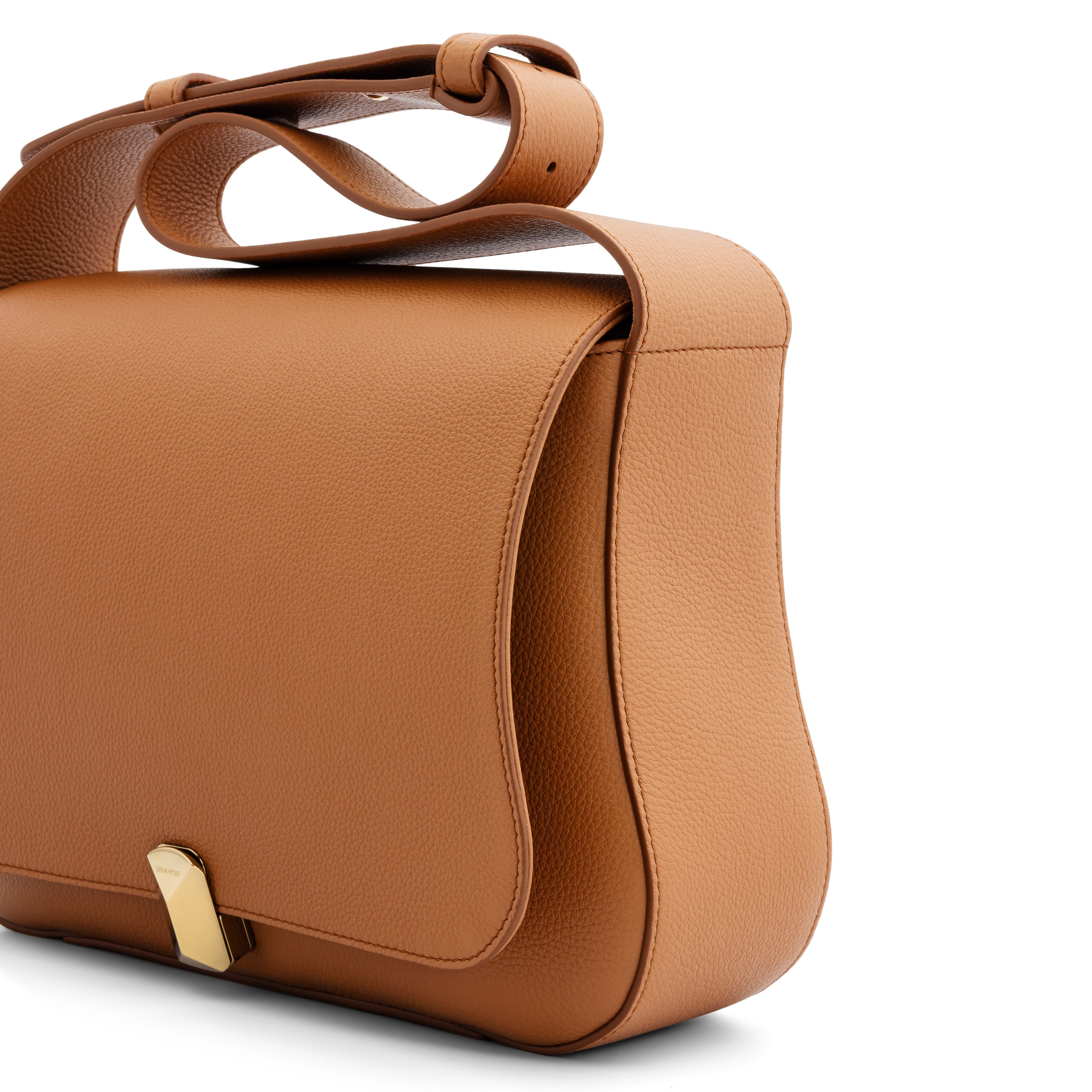
Why we make our handbags in Italy and why how they are made matters even more.
At Siena wolf, craftsmanship has been at the heart of our approach from the beginning. We believe what makes something exceptional is defined not by geography alone, but by the knowledge, materials, standards, relationships, and people behind the making.
Today, our handbags are handcrafted just outside Florence, Italy, in a family owned workshop that brings together skilled craftsmanship, modern precision, technical expertise, and a shared commitment to quality.
We are proud to make in a region with a remarkable leatherworking heritage, but our decision to produce in Italy has never been about the prestige of a label alone. It is about finding the people and capabilities that allow us to uphold the standards we have set for Siena Wolf.
For us, Made in Italy is not the beginning of the story. It is the result of everything that comes before it.
Why We Chose Italy
When Siena Wolf was created, craftsmanship was never intended to be a finishing touch. It was meant to inform every decision, from design and material selection to construction and production.
We set out to create handbags in which beauty and function exist in balance, made with materials and methods worthy of the design. Finding the right manufacturing partner was therefore not simply a production decision; it was fundamental to the kind of house we wanted to build.
Exceptional craftsmanship is not confined to one country. Around the world, there are regions, workshops, and makers with extraordinary expertise in their respective crafts.
Siena Wolf seeks expertise where expertise lives.
For leather goods, Italy was a natural place to begin. Its longstanding leatherworking tradition has fostered a concentration of skilled makers, specialized manufacturers, tanneries, and suppliers. An established ecosystem of expertise that offered many of the capabilities we were seeking as we began building Siena Wolf.
What ultimately kept us there was not reputation alone. It was what we found: a family owned workshop just outside Florence with skilled artisans, technical expertise, modern capabilities, a collaborative approach, and a commitment to quality that aligned with the standards we had established for Siena Wolf.
Italy's leatherworking heritage provided an important foundation, but heritage alone was not enough. We were looking for a partner capable of translating contemporary design into beautifully constructed handbags while bringing technical knowledge, precision, testing, and a willingness to collaborate throughout the development process.
Leather itself demands this kind of expertise. As a natural material, its characteristics can vary, and different leathers respond differently to cutting, folding, stitching, reinforcing, turning, edge finishing, and shaping. A material that works beautifully for one silhouette may not be right for another, and the same design interpreted in a different leather can require adjustments in construction.
The artisans who make our handbags bring their experience and judgment to these decisions. Their expertise can be found in the understanding of materials, in construction and finishing, and in knowing how seemingly small adjustments can influence the way a handbag holds its shape, how a handle sits, or how a finished edge appears.
At our workshop, skilled craftsmanship is complemented by modern precision, technical testing, and an understanding of how a beautifully made handbag should perform.
That combination of craft, technical expertise, and collaboration is ultimately why we chose to make here.
A Handbag Begins Long Before It Is Made
The making of a Siena Wolf handbag begins long before the first piece of leather is cut.
It begins with design.
A silhouette is considered not only for how it looks, but for how it will function in everyday life. Proportion, scale, structure, capacity, access, strap placement, hardware, interior organization, all have to work together. Beauty and function are not separate considerations; each informs the other.
Then comes development. The process of translating an idea into a three dimensional object.
Patterns are created. Materials and construction methods are considerred. Prototypes allow us to see, hold, and experience the design in a way a drawing cannot. Revealing what works, and, just as importantly, what needs to change.
Sometimes those changes are subtle. A fraction of an inch can alter the proportion of a silhouette. The weight or placement of hardware can affect balance. The length or position of a strap can change how a bag sits against the body. A leather that is beautiful in its own right may not provide the structure or softness a particular design requires.
Each decision influences another, and refinement is part of the process.
This is where collaboration with experienced makers becomes particularly valuable. A design establishes the vision; craftsmanship and technical expertise help determine how that vision can best be realized.
What begins as an idea gradually becomes something that can be held, carried, and lived with.
Craftsmanship Is Also Collaboration
We do not view our workshop simply as a place where Siena Wolf handbags are manufactured. The relationship is collaborative.
Our relationship with the workshop extends beyond production. We work closely with the team throughout the development of our designs, drawing on their technical knowledge and experience as ideas are translated into finished pieces. Visiting the workshop has also given us the opportunity to better understand its capabilities, processes, and approach to making.
That connection matters. It allows us to ask questions, exchange ideas, learn from the expertise of our partners, and remain engaged with how Siena Wolf handbags are developed and made as the collection evolves.
That exchange between design and making is an important part of our process.
Our signature turn-lock is one example.
Rather than selecting an existing closure, we chose to develop one specifically for Siena Wolf, an original detail intended to become part of the house's design language. Transforming the idea into functional hardware required collaboration with our workshop and a specialist Italian hardware manufacturer, translating the original design into a component that could be engineered, refined, finished, and ultimately integrated into the construction of our handbags.
What appears effortless in a finished piece can require numerous decisions behind the scenes. That is often the nature of craftsmanship: when something has been thoughtfully resolved, the complexity behind it almost disappears.
Tested With Purpose
Craftsmanship is not only about what can be seen on the surface. It is also about understanding how a handbag and its materials are expected to perform over time.
During one of my visits to our workshop just outside Florence, I had the opportunity to see its testing laboratory firsthand, a part of the making process that a customer may never see, but one that left a lasting impression on me.
Among the testing I observed was a leather bag carrying a substantial weight while its construction was evaluated under stress. Although it was not a Siena Wolf design, watching the test offered a glimpse into a side of handbag making rarely seen by the person who ultimately carries the finished piece.
Within the laboratory, materials and components can be evaluated to better understand how they respond to wear and use. Leather can be assessed for performance, while technical testing can provide another perspective on qualities that cannot always be determined by appearance or touch alone.
Seeing the laboratory reinforced something I have come to appreciate deeply: craftsmanship isn't only about the skill of the hand. It is also about knowledge, understanding materials, anticipating how they may perform, testing assumptions, and applying that information throughout the making process.
Technical testing complements the expertise of the artisan. The hand and eye of an experienced maker can reveal a great deal about a material; how it feels, how it responds to construction, and whether it is appropriate for a particular silhouette. Testing offers another layer of understanding.
This intersection of skilled craftsmanship and technical knowledge is something we value deeply.
A Siena Wolf handbag is designed to be beautiful, but beauty is only one part of the equation. How it will be carried, how its materials will respond to use, how its construction will perform, and how its individual components work together are all part of creating the finished piece.
Much of what determines the quality of a handbag may never be visible to the person who carries it, but it matters.
The Material Is Part of the Design
Leather is never an afterthought at Siena Wolf.
We select premium leathers from leading tanneries based not only on their beauty, but on how each material will perform within a particular design.
Leather is a natural material, with characteristics that influence how it looks, feels, shapes, and responds to construction. Structure matters. So does softness. Grain, hand feel, thickness, flexibility, durability, and the way a leather behaves when cut, folded, stitched, and formed all influence our choices.
A leather selected for a structured top handle bag may require very different qualities from the supple Nappa used for a softer silhouette. Full grain calfskin brings another character altogether, allowing the natural grain and individuality of the hide to remain more visible.
These choices affect more than appearance. The leather contributes to the structure of the bag, the way it feels in the hand, the way it carries, and ultimately how successfully the original design is realized.
Ultimately, material selection is not about choosing leather in isolation. It is about choosing the right leather for the design.
Exceptional materials alone do not create an exceptional handbag. Design, material, construction, and craftsmanship must work together, each supporting the other to create the finished piece.
Responsibility Begins With the Materials
How our materials are produced matters alongside their beauty and performance.
We source our leathers from leading tanneries certified by the Leather Working Group, an independent organization that assesses leather manufacturers against standards spanning environmental performance, chemical and water management, energy use, waste, traceability, and health and safety.
For Siena Wolf, working with certified tanneries provides an additional level of accountability within our supply chain and helps us make more informed decisions about where our materials come from and how they are produced.
Certification, however, is not the same as perfection. Every material and manufacturing process has an impact, and we do not believe responsible creation can be defined by a single certification or claim.
Instead, we see responsibility as an ongoing process. As Siena Wolf grows, we are working to deepen our understanding of our materials and supply chain, ask more questions of the partners with whom we work, and make increasingly informed decisions about how and where our products are made.
Responsible creation, for us, begins with understanding more about how something is made and recognizing that there is always more to learn.
The Broader Standards Behind European Production
Our approach to responsible creation extends beyond leather.
Producing in Italy also places our current manufacturing within the broader regulatory framework of the European Union, where requirements address areas relevant to production including chemical safety, environmental protection, industrial processes, and worker health and safety.
These regulations do not, on their own, guarantee that a product has been responsibly made. Nor are they a substitute for understanding the manufacturers and suppliers behind a product. They do, however, provide an established framework within which our current European production operates.
For Siena Wolf, that matters.
As we grow, we want to build upon that foundation by developing a deeper understanding of our supply chain, asking more questions, and continuing to learn about the practices and standards of the partners with whom we work.
We believe responsible creation is something that develops through greater knowledge, thoughtful choices, and strong relationships.
As an independent house, being connected to the people and businesses behind what we make is something we value deeply.
The Human Touch
Throughout the making of a Siena Wolf handbag, skilled hands cut, assemble, stitch, finish, and inspect the piece. Modern technology and precision have an important place in the process, but they do not eliminate the value of human expertise.
Leather itself is a reminder of why that expertise matters. As a natural material, no two hides are exactly alike. Variations in grain, texture, and character require an experienced eye and an understanding of how the material can best be used within a particular piece.
Construction requires judgment as well. An experienced artisan can see and feel things that are difficult to communicate through measurements alone. The alignment of components, the finish of an edge, the balance of a silhouette, or the way individual elements come together in the finished bag.
These decisions rarely call attention to themselves. In fact, when they are made well, the person carrying the bag may never consciously notice them. Collectively, they contribute to something that can be felt: the difference between an object that has simply been produced and one that feels beautifully made.
The Details You May Never Notice
At Siena Wolf, we often talk about details.
Not because every detail needs to be noticed, but because many of the most important ones should almost disappear into the experience of carrying the bag.
The precision of the stitching. The finish of an edge. Hardware that feels substantial and operates smoothly. A closure that feels intuitive. A handle that is balanced. A strap that sits comfortably. An interior considered for the way the bag will actually be used. And, ultimately, a silhouette that retains the character and intention of the original design.
These things can be easy to take for granted when they work beautifully. That is precisely the point.
No single detail makes a Siena Wolf handbag. Together, they create the whole.
It is the idea behind one of our founding beliefs: True elegance lies in the details.
Why Small Batch Production Matters
Siena Wolf handbags are produced in small batches and never mass produced.
For us, small batch production is not about creating scarcity for its own sake. It reflects the way we want to build the house: deliberately, with a closer connection to what we make and the partners who make it.
Producing in smaller quantities allows us to remain closer to our collections and inventory and to make production decisions based more closely on our needs, rather than committing to larger quantities simply for the efficiencies of scale.
We also look for opportunities to make more thoughtful use of the materials already within our production process. Leather remaining from handbag production has been repurposed for our cardholders, giving beautiful material another purpose. As we develop future pieces, we continue to explore ways to extend this approach to other small leather goods and accessories.
None of these choices, on its own, defines responsible production. But we believe responsible creation is often built through a series of thoughtful decisions made consistently over time.
Designed for Longevity
Responsible creation extends beyond how something is produced. It also asks us to consider what we are putting into the world in the first place.
For Siena Wolf, that means creating pieces with a reason to endure. Quality materials and construction are part of that equation, but so are thoughtful function and a design perspective intended to remain relevant beyond a single season.
Longevity is both physical and emotional. A handbag can be beautifully constructed, but its value as a lasting object is diminished if its owner quickly loses the desire to carry it.
We therefore look for a particular balance in our designs: distinctive without being dependent on novelty, contemporary without being defined by a passing trend.
Function matters, too. A piece that works beautifully in everyday life has more reason to remain part of it. How a bag carries, what it holds, how easily it can be accessed, and how naturally it moves between different moments all contribute to its usefulness over time.
Our goal is to create handbags that continue to feel relevant, useful, and beautiful. Pieces with enough character to feel distinctive, but not so tied to a moment that their appeal disappears with it. Perhaps the most meaningful measure of longevity is whether something remains worthy of being reached for, carried, cared for, and kept.
What Made in Italy Means to Siena Wolf
We believe exceptional craftsmanship can exist in many places. Around the world, skilled makers and specialized workshops bring extraordinary knowledge to their respective crafts.
A country of origin label alone cannot tell us whether something has been beautifully or responsibly made. That is why what stands behind the label matters.
For Siena Wolf today, Italy brings together many of the qualities we value: skilled artisans, specialized manufacturers, leather working expertise, access to exceptional materials and suppliers, collaborative product development, and a regulatory framework that supports many of the standards important to responsible production.
We are proud that our handbags are made in Italy, but, we would never want those three words to be the only reason someone believes a Siena Wolf handbag has value.
The deeper story is in the making.
It is in the design and the leather selected for a particular silhouette. In the pattern and construction beneath the surface. In the custom hardware developed for the house and the hand finished details. In the expertise of the people who bring these elements together and the many decisions made along the way.
It is also in the choices we continue to make about how much we produce, how we use our materials, and how we deepen our understanding of the partners and processes behind what we create.
That is what Made in Italy means to us.
Wherever the future takes Siena Wolf, the principle behind it remains the same:
Where something is made is part of its story. What matters most is the craftsmanship, materials, people, and standards behind its making.